
What Does "Yard Sanitizing" Actually Mean? An Honest Answer for Newbury Park, Westlake Village, and Lake Sherwood
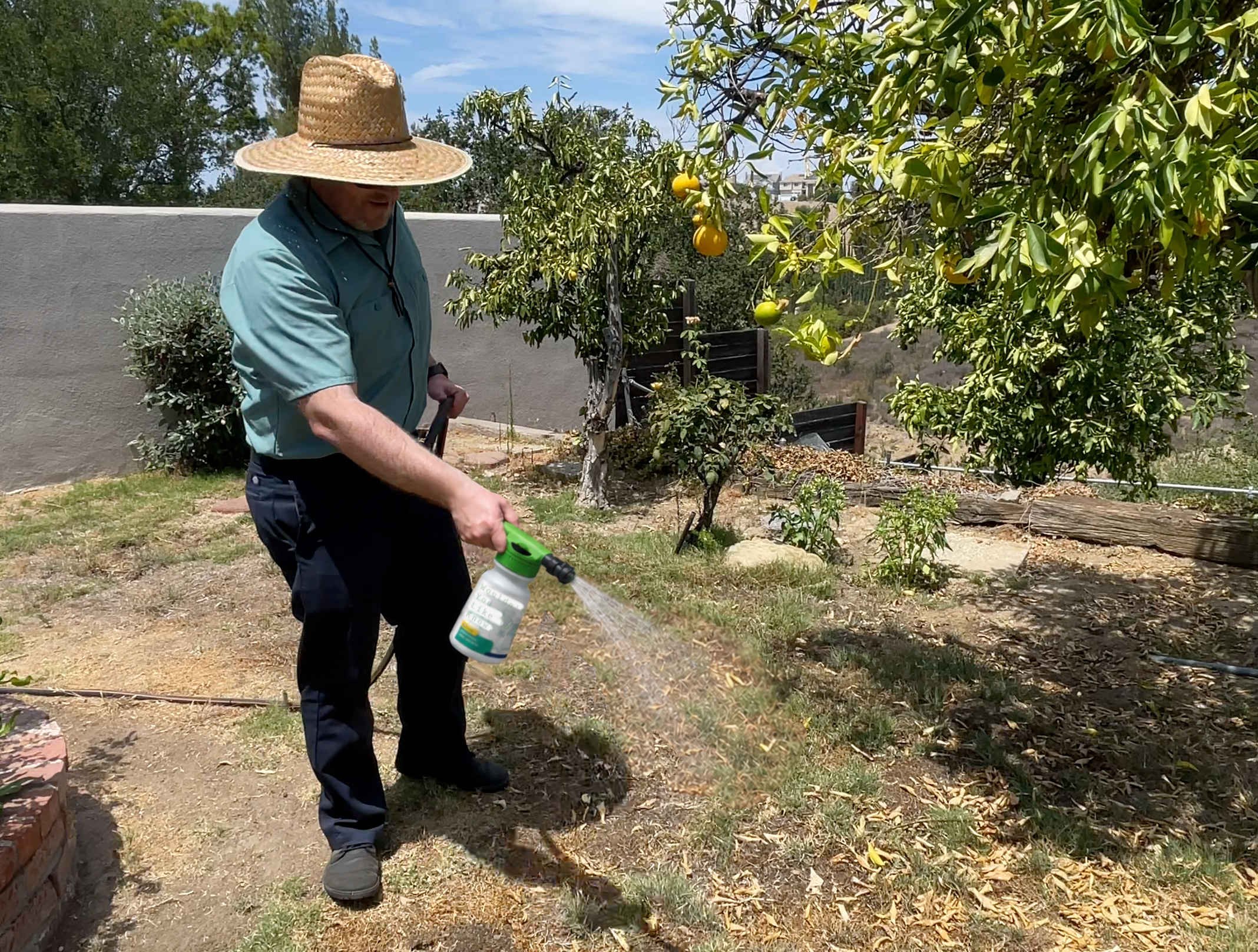
Deodorizing, not sanitizing — the right product for natural grass.
Short answer: Almost every pet waste removal company in the Conejo Valley now advertises sanitizing. Very few explain what it does, where it works, and where it does not. Here is the honest version: on hard surfaces, kennels, gravel and artificial turf, sanitizing does real work. On natural grass, it does far less than most marketing implies. The thing that actually protects your yard is consistent waste removal — and that is true whether you hire us, hire someone else, or do it yourself.
If you searched pet waste removal near me hoping for a straight answer instead of a sales pitch, that is what the rest of this page is.
What is sanitizing supposed to do?
Sanitizing means applying a product that reduces microorganisms on a surface.
Two conditions have to be met for it to work at all. First, the organic material has to come off the surface first — waste, debris, buildup. Sanitizers are inactivated by organic matter, which is why every professional protocol starts with removal, not spraying. Second, the product has to stay wet on the surface for a specified contact time, usually measured in minutes.
Both conditions are easy to meet on a kennel floor, a concrete patio, a gravel run, or artificial turf. Those are defined surfaces. You can clear them, wet them evenly, and let them sit.
Why is natural grass different?
Because grass is not a surface. It is a living, three-dimensional layer sitting on soil.
A lawn holds thatch, root zone, loose soil and organic matter several inches deep. A spray wets the blades and the top layer. It does not reach and hold contact with everything underneath, and the organic material it does reach begins neutralizing it immediately.
This is not a fringe opinion. It is the standard position in veterinary guidance on environmental decontamination, which consistently identifies grass and soil as surfaces that are difficult to properly sanitize, in contrast to sealed concrete. Guidance written for households recovering from an actual parvovirus case does not describe a one-and-done spray. It describes removing organic material, saturating, drying, and repeating — while stating plainly that complete elimination outdoors is not achievable.
What do public dog parks do, then?
Considerably less than people assume, and that is informative.
Conejo Creek Dog Park in Thousand Oaks — three and a half acres, heavily used, largely grass — closes weekly for maintenance and once more for a full day each month. It provides waste bag dispensers and posts rules. There is no published program of chemical sanitizing of the turf.
That is not negligence. It reflects what actually works on grass at scale: keep waste picked up, keep the turf mowed and draining, and let sun and time do the rest. The Conejo Recreation & Park District has also been converting several off-leash areas away from grass entirely toward compacted natural earth surfacing.
If routine turf sanitizing were the effective intervention, the agencies managing the highest-traffic dog areas in the valley would be doing it. They are not. The pattern holds everywhere we have looked: pet waste removal, done consistently, is the intervention that actually works.
What should you ask a company that advertises sanitizing?
Four questions. The answers will tell you a lot.
"What product do you use, and is it EPA-registered?" A real sanitizer is a registered pesticide with a registration number. Ask for it. Any company using one should be able to give it to you in about five seconds.
"What does the product's label say it is approved for?" This matters more than the marketing. Approved uses and approved claims are specific and public. A company that cannot tell you what is actually on the label is repeating a brochure.
"Do you remove the waste before you spray, or at the same time?" If sanitizing happens over organic material, it is mostly theater. Removal comes first or the step does not do what it claims.
"What do you do about runoff?" Chlorine-based sanitizers are commonly labeled as toxic to fish and aquatic organisms. On a sloped property, or anywhere draining toward a creek or storm drain, that is a real consideration, not a technicality. A company that has never thought about it has not read its own product's label.
Be especially skeptical of anyone promising that yard sanitizing will protect your dog from parvovirus. Parvo is extraordinarily durable in soil, and no reputable veterinary source claims an outdoor surface can be reliably cleared of it. Vaccination is what protects your dog. Anyone selling you a yard treatment as a substitute is selling you something that does not exist.
What CaliPet does — and what we will not do
We remove waste first, every visit. This is the actual pathogen control. It is the same thing the parks do, and it is the single highest-value thing any pet waste removal service provides. Frequency matters more here than any product does.
On grass, we deodorize. Odor is caused largely by ammonia-nitrogen compounds, and treating it is straightforward and effective. We use an organic deodorizer on natural turf. It does what it says: your yard smells clean.
On kennels, runs, artificial turf, gravel, concrete and other hard surfaces, we sanitize properly. These are surfaces where sanitizing genuinely works, where contact time can be achieved, and where the label supports it. We pre-clean, apply, and observe the product's directions.
We will not spray sanitizer across your natural lawn and call it disease protection. We could. It would be easy to sell and nobody would check. We are not going to, because it overstates what the chemistry does on grass and because repeatedly applying chlorine-based product across an entire residential yard raises real questions about soil, runoff, and the watershed — and in Newbury Park and around Lake Sherwood, plenty of properties drain toward open space and creek corridors.
If you want sanitizing on your grass anyway, tell us and we will have an honest conversation about it rather than a sales pitch.
Frequently asked questions
Is sanitizing included in your plans? Deodorizing and sanitizing are included with every recurring plan, at a frequency we set with you. Where they get applied depends on the surface, for the reasons above.
Can I choose deodorizing only? Yes. A lot of households do, and for many yards it is the right call.
Does this mean sanitizing is pointless? No. On the right surfaces it does real work — kennels and runs especially, and artificial turf, which a lot of homes in this area have. The point is that surface type determines whether it helps, and honest companies should say so.
What actually protects my dog? Vaccination and parasite prevention through your veterinarian, plus consistent waste removal so contaminated material is not sitting in the yard. We handle the second part. Your vet handles the first, and that conversation is worth having.
Which areas do you serve? Newbury Park, Westlake Village, Lake Sherwood, Thousand Oaks, Agoura Hills, Oak Park, Calabasas, Hidden Hills, Woodland Hills, West Hills, Canoga Park, plus Malibu and Topanga Canyon and the rest of the Conejo Valley and surrounding areas.
Get a quote
If you have been looking for a dog poop service or a pooper scooper near me and getting a lot of confident claims that nobody will explain, ask us anything. We will tell you what we know, what we do not, and what we will not promise.
Tell us your ZIP code, how many dogs, and what your yard surface is — grass, turf, gravel, or a mix. New recurring clients get their first week free, and that first visit is the cleanup.